Why maintenance is the biggest operational bottleneck in property management
Maintenance coordination is taking more time across PM teams. Explore why admin, communication and repetitive setup work are creating pressure for property managers, and how AI is starting to help reduce the load.
A leaking tap sounds simple enough.
Until it turns into:
- Five emails
- Two phone calls
- A quote request
- Checking maintenance limits
- Digging through old notes
- Chasing a tradie
- Updating the owner
- Replying to another “just checking for an update” email from the tenant
That’s usually the part people outside property management don’t see.
The repair itself is usually the easy part. The admin around it is what drags things out.
We recently asked PM teams where their workflow still feels the most manual.
Maintenance coordination came out on top at 31.25%, ahead of lease renewals, compliance tracking and arrears follow up.
.png)
And honestly, it's not surprising.
Every maintenance request brings admin, follow ups, approvals and context-switching with it.
That workload stacks up quickly across your portfolio.
And the bigger your portfolio gets, the heavier that pressure becomes.
The real workload starts before the work order
A tenant logs a maintenance request in under 60 seconds.
You then spend the next 20 minutes piecing together context.
What’s the owner approval limit?
Who handled this property last time?
Is there already a preferred tradie?
Has this issue happened before?
What does the management agreement say?
Did the contractor ever send that invoice from the last job?
None of these tasks are difficult on their own.
Together though, they create friction all day long.
And that operational drag adds up fast across hundreds of properties.
You’re spending too much time on “setup work”
A huge chunk of maintenance coordination comes down to preparation work before you can even action the job.
- Reading through notes
- Finding missed details
- Drafting emails
- Checking limits
- Reviewing previous jobs
- Figuring out the next step before the real work begins
That’s where you lose time you don’t really have.
Especially now, when response times are under more pressure than ever.
In our State of the Australian Real Estate 2026 report, nearly half of agencies (49.9%) said tenants are asking for faster response times.
That expectation changes the pace you’re working at every day.
A delayed update that might’ve been acceptable a few years ago now triggers follow ups almost immediately.
You’re now managing expectations, response times, contractor relationships, compliance, documentation and communication history all at once.
This is where AI is starting to become genuinely useful
Not the gimmicky kind of AI. We're talking about the useful stuff that's much more practical or operational.
Things like:
- Summarising maintenance requests
- Recommending the next action
- Drafting quote requests
- Preparing work orders
- Surfacing missing information
- Checking management agreements
- Identifying preferred tradies based on previous jobs
- Pulling context together faster
Basically, reducing the repetitive groundwork that slows you down every day.
That’s where AI starts becoming genuinely useful for property management teams.
The biggest opportunities right now are sitting around repetitive admin and operational clutter that eats into your day.
Agencies are looking closely at operational pressure
Some agencies are growing headcount to handle workload pressure.
Others are trying to reduce the workload sitting behind each task in the first place.
- Fewer manual touchpoints
- Less hunting for information
- Less reactive admin
- Fewer repeated checks
- More consistency across the team
That creates a smoother workflow across portfolios, especially when staff change over or agencies scale.
It also helps standardise the experience for tenants and owners.
One PM might have 10 years experience. Another might be 6 months into the role.
Consistency becomes difficult when processes rely heavily on memory or personal habits.
A good process should still hold together on a busy Friday afternoon when half the team is tied up in inspections and someone’s calling about a burst hot water system.
That’s usually the real test.
Trust matters when AI enters workflows
Most PMs are understandably cautious about AI being dropped into maintenance workflows.
Fair nuff too.
You have too many moving parts for blind automation.
Every agency has different owners, different maintenance limits, different contractor relationships, and different internal processes.
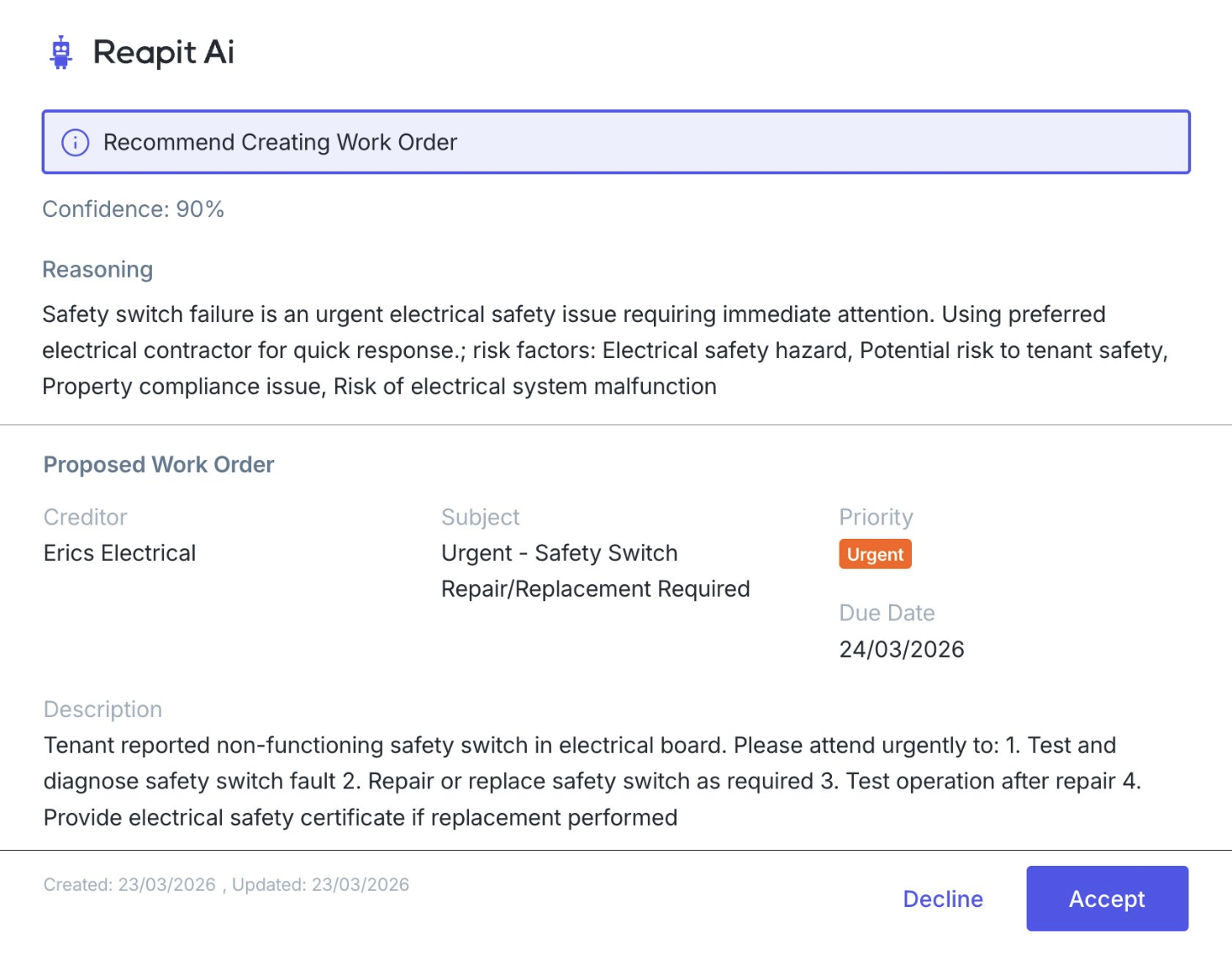
The more practical tools give you visibility into recommendations, reasoning and confidence levels before anything gets actioned.
That visibility matters.
Systems become far more valuable when they learn from an agency’s existing workflows, tradies, notes and historical decisions.
That context helps reduce repetitive setup work you deal with every day while still keeping you in control.
Kinda like having an assistant who already knows which tradies your team trusts, where the maintenance limits sit and how urgent jobs are usually handled.
Minus needing another desk in the office.
Maintenance workflows are starting to change
AI conversations in property management are becoming far more operational.
The focus is shifting toward the workflows that consume the most time day to day, especially maintenance coordination.
That’s where the value becomes tangible for your team.
- Faster response times.
- Less admin.
- More consistency.
- Fewer missed details.
- Less back-and-forth.
- Less burnout across busy portfolios.
At Ascend '26, we recently introduced Reapit AI (RAI) into maintenance workflows to help PM teams reduce the repetitive groundwork involved in handling maintenance requests.
The assistant uses your agency’s own historical data to recommend next steps, prepare quote requests, and draft work orders, while still keeping you fully in control of every decision.
Most PMs already know how to manage maintenance well.
The real challenge is the volume of admin, coordination, and follow up work attached to every request.
see more blogs
Related content